
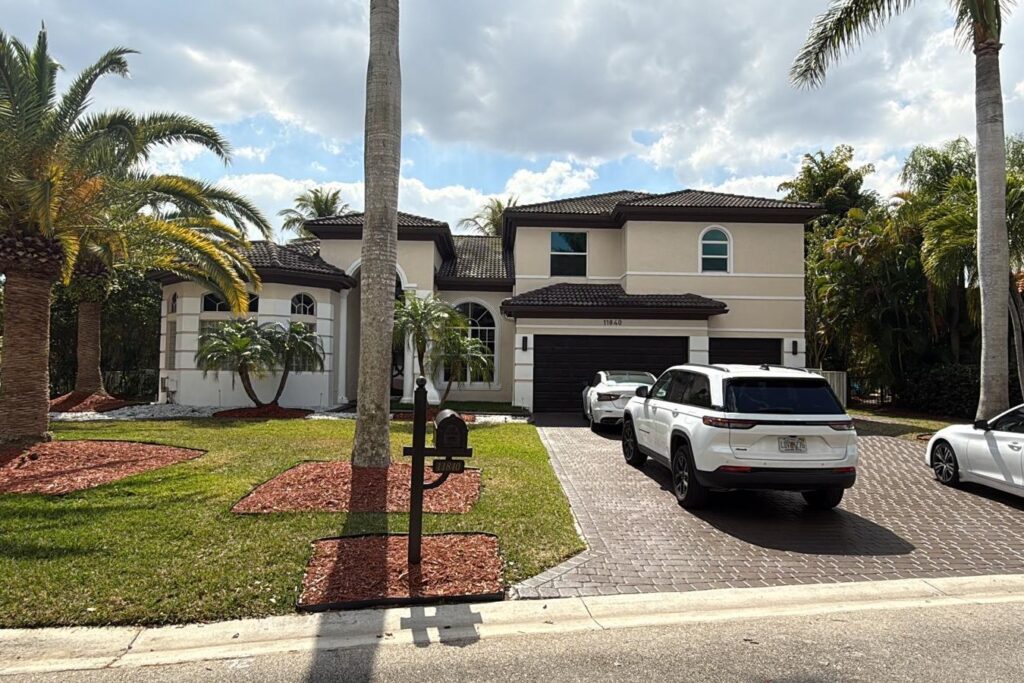
Short answer: In the South Florida market, asphalt shingle replacement typically runs somewhere around $5 to $9 per square foot installed, putting a common 2,000 square foot roof roughly in the $10,000 to $18,000 range. Flat and torch-down systems commonly run $6 to $12 per square foot. Concrete and clay tile typically run $10 to $20, and standing seam metal $12 to $20 or more. Those are typical market ranges rather than quotes. What moves your number most is the material, how many layers come off, whether the decking needs work, and the code requirements that apply once the roof is opened up.
Roofing gets quoted by the square, which is 100 square feet. So a 2,000 square foot roof is 20 squares. Knowing that makes every quote you receive easier to compare.
Here is what actually decides the figure.
Cost by material
| Material | Typical installed range | Notes |
|---|---|---|
| Asphalt shingle | $5 to $9 / sq ft | Most common, shortest life in this climate |
| Flat / torch-down (modified bitumen) | $6 to $12 / sq ft | Common on low-slope sections |
| Concrete or clay tile | $10 to $20 / sq ft | Long-lived, heavy, labor-intensive |
| Standing seam metal | $12 to $20+ / sq ft | Highest up front, longest life, best wind performance |
Typical United States and South Florida market ranges, not KGR quotes. Every one of these swings with pitch, complexity, access and what is found under the old roof.
A note on comparing materials honestly: the cheapest per square foot is not automatically the cheapest per year. In this climate, sun and salt air are hard on asphalt, and a shingle roof that needs replacing again in fifteen years is a different proposition from a metal or tile roof that does not. Whether that trade is worth it depends on how long you plan to own the house.
What actually moves the price
| Factor | Effect |
|---|---|
| Square footage | The baseline. Larger roofs cost less per square |
| Pitch | Steeper is slower, needs more safety equipment, costs more |
| Complexity | Valleys, hips, dormers, skylights and penetrations all add labor |
| Tear-off layers | Removing two layers costs more than one, in labor and disposal |
| Decking condition | The big unknown. Rotted or delaminated sheathing has to be replaced |
| Code upgrades | Secondary water barrier and current fastening schedules are required on replacement |
| Product approval | Hurricane-zone products carry approvals and cost accordingly |
| Permits and inspections | Required, and priced differently by municipality |
| Access | Two-story, tight lots, limited staging space |
| Disposal | Tile in particular is heavy and expensive to haul |
| HOA requirements | Some communities mandate specific materials or colors |
Decking is the line item most likely to move after work starts, and any honest contractor will tell you that up front. Nobody knows what is under the old roof until it comes off. A good quote states a per-sheet price for replacement decking so there are no surprises about the rate, even if the quantity is unknown.
The South Florida factors
Code is not optional here. A replacement roof in the hurricane zone has to meet current requirements, which include a secondary water barrier and enhanced fastening. Coastal counties layer their own requirements on top, and product approvals for wind uplift are part of the specification rather than a nicety. This is a real component of the cost and it is also the reason a Florida roof costs more than the same roof in a mild-weather state.
Rules about partial work have changed. There are provisions governing how much of a roof can be repaired before the whole assembly must be brought to code, and those provisions have been amended more than once. What applies depends on when your roof was built and where you are. Confirm with your contractor and your local building department for your specific address rather than relying on what was true a few years ago.
Sun and salt shorten everything. Ultraviolet exposure is relentless, and closer to the coast salt air accelerates corrosion of fasteners and flashing. Materials that last thirty years elsewhere do not necessarily last thirty years here.
Insurance interacts with all of it. Carriers increasingly care about roof age and condition. An older roof can affect what coverage is available and on what terms, which for some homeowners becomes the actual reason to replace. Worth checking where you stand with your carrier before deciding to wait another season.
The wind mitigation point worth knowing
After a replacement to current code, a wind mitigation inspection documents the features your new roof has: fastening, secondary water barrier, roof-to-wall connections and roof geometry.
Those features can qualify for insurance premium credits in Florida, and the inspection itself is inexpensive relative to what it can return. It is one of the few genuinely reliable ways a replacement partially pays for itself over time.
Ask your contractor whether the specification supports the credits you are hoping for, before the work is done. Some decisions that affect the report cost little at installation and cannot be retrofitted cheaply afterwards.
Where quotes legitimately differ
Two honest quotes on the same roof can be thousands apart. The usual reasons:
- Different underlayment specification. A significant cost and quality difference that is invisible once installed
- Decking allowance. One quote includes replacement sheets, another prices them as an extra
- Tear-off scope. How many layers, and whether disposal is included
- Fastening. Meeting code versus exceeding it
- Flashing. Reusing existing flashing versus replacing it. Reused flashing on a new roof is a common shortcut
- Warranty. Manufacturer warranty tiers depend on the installer’s certification and on system components being from one manufacturer. Labor warranty length varies a lot
- Permit handling. Whether it is included
What is not a legitimate difference: skipping the permit, reusing flashing that should be replaced, or a number so far below the others that scope has quietly been removed. If one quote is dramatically cheaper, ask what the others include that it does not.
What a quote should itemize
- Total squares, and the pitch
- Material, with manufacturer and product line
- Underlayment specification
- Fastening schedule
- Tear-off scope and number of layers
- Decking replacement rate per sheet
- Flashing, whether new or reused
- Permit and inspection handling
- Manufacturer warranty tier and labor warranty
- Payment schedule
- Timeline, and what happens if weather interrupts
Get all of it in writing. A one-line quote with a single number is not something you can evaluate.
Frequently asked questions
How much does a roof replacement cost in South Florida?
Typical market ranges run about $5 to $9 per square foot for asphalt shingle, $6 to $12 for flat and torch-down, $10 to $20 for tile, and $12 to $20 or more for standing seam metal. A common 2,000 square foot shingle roof therefore often lands somewhere between $10,000 and $18,000. These are general ranges, not quotes.
Why are Florida roofs more expensive than in other states?
Hurricane-zone code. Replacement roofs here require a secondary water barrier, enhanced fastening and products carrying wind uplift approvals, with additional requirements in coastal counties. That specification is a real cost, and it is also why a properly built Florida roof performs the way it does in a storm.
How long does a roof replacement take?
A straightforward shingle replacement on an average home is commonly a few days. Tile and metal take longer, complex roofs take longer, and finding damaged decking extends it. Weather is the other variable, particularly in summer.
Will my insurance pay for a roof replacement?
It depends on the cause, the age and condition of the roof, and your policy. Sudden storm damage is treated very differently from age-related wear, and no contractor can promise an outcome. If the damage came from a storm, documentation from the time matters enormously.
Is it cheaper to repair or replace a roof?
A repair is cheaper in the moment and is the right answer for localized damage on a roof with life left. It stops being the cheaper option on a roof near the end of its service life, where repeated repairs postpone a decision you will make anyway. Rules about partial work triggering code compliance can also change the math.
Does a new roof lower my insurance premium?
It can. A wind mitigation inspection after a code-compliant replacement documents features that may qualify for premium credits in Florida. The credits vary by carrier and by what your roof actually has, so it is worth discussing the specification with your contractor before work starts.
Get a real number for your roof
We will measure the roof, tell you what specification it actually needs, and give you a written quote that itemizes the parts above rather than a single figure with nothing behind it.
Call KGR Builders & Roofing at (954) 440-6068 or request a free estimate. We replace shingle, tile, metal and flat roofs across South Florida from Homestead to West Palm Beach, including Fort Lauderdale.
If a storm is what brought you here, start with storm damage: repair or replacement.