
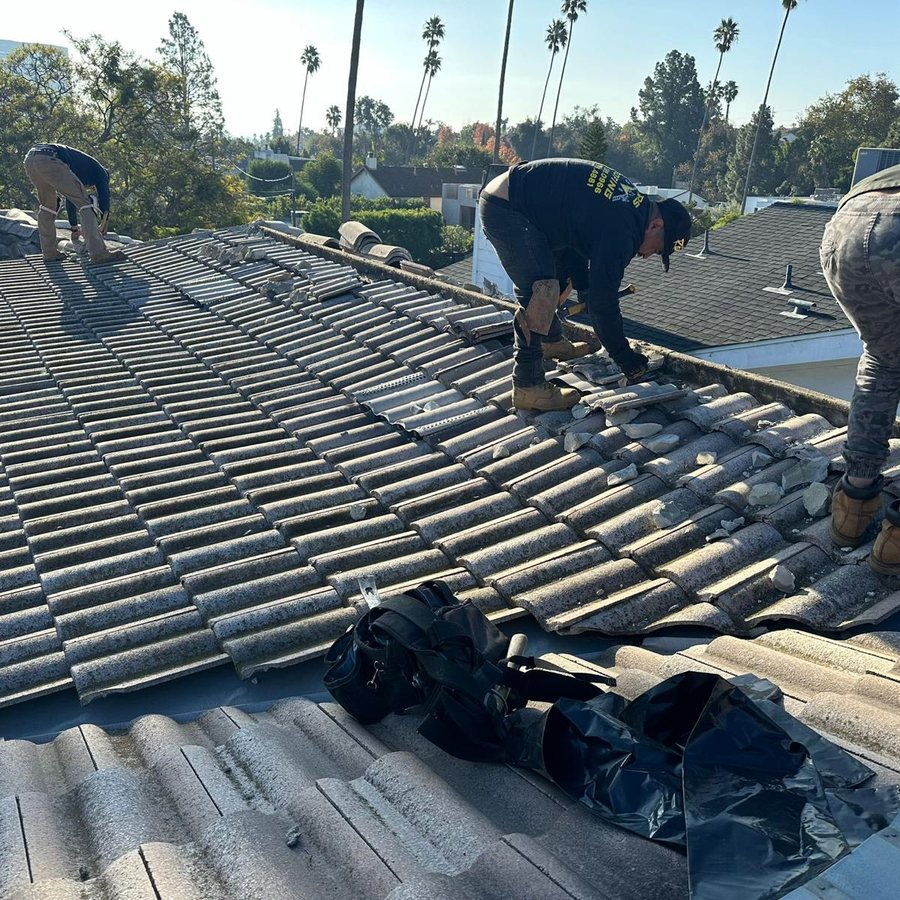
Short answer: After a storm, the honest answer depends on whether the damage is localized or systemic. A few lifted shingles, one displaced tile, or a single failed flashing detail on an otherwise sound roof is a repair. Widespread wind uplift across multiple slopes, damage to the underlayment, a roof already near the end of its service life, or water that has reached the decking usually means replacement. In South Florida the deciding factor is often not the visible damage at all, it is what the wind did to the fastening and the layers underneath.
A storm passes, you find debris in the yard and a few pieces of your roof with it, and the immediate question is how bad it is.
Here is how that actually gets decided, and what to do in what order.
First, the order of operations
- Document everything before anything is touched. Photograph the roof from the ground, the debris, the yard, any interior water, and the date. This is the evidence an insurer works from and it cannot be recreated later
- Prevent further damage, if you safely can. Insurers generally expect you to mitigate. A tarp over an open area is reasonable. Getting on a storm-damaged roof yourself is not
- Do not throw anything away. Displaced tiles, torn shingles, sections of flashing. All of it is evidence
- Get a professional assessment, ideally before you file, so you know what you actually have
- Then file the claim, with documentation already in hand
- Be careful who knocks on your door. Storm-chasing crews follow weather in South Florida. Verify a license, a local address, and a real history before signing anything
On timing: Florida has changed both its roofing requirements and its claim deadlines more than once in recent years, and the current rules are not what many homeowners remember. Do not assume you have as long as you used to. Confirm the current deadline with your carrier or agent, early.
What wind actually does to a roof
The visible damage is rarely the whole story, and this is the part that decides repair versus replacement.
Wind does not lift a roof evenly. It creates uplift pressure that is highest at the edges, corners and ridge. So the damage concentrates where the roof is fastened rather than in the middle of a slope. A roof can look almost untouched from the street and have lost its edge fastening.
Wind-driven rain gets in where vertical rain never would. Pushed sideways and upward, it goes under tile courses, behind flashing, past ridge details and into terminations. That is why interior water can appear after a storm on a roof with no obvious hole.
Uplift fatigues fasteners across the whole roof, not just where the material came off. If wind was strong enough to remove shingles from one slope, it worked on every other slope too. The section that failed is the weakest point, not the only affected one.
That last point is the crux of most repair-versus-replacement disagreements. What looks like three damaged squares is often a roof whose fastening has been compromised generally.
Repair or replacement
| Situation | Usually |
|---|---|
| A few shingles or tiles displaced, roof otherwise young and sound | Repair |
| One flashing detail or vent boot failed | Repair |
| Damage across multiple slopes or concentrated at edges and ridge | Replacement |
| Underlayment torn or exposed over an area | Replacement |
| Water has reached the decking | Replacement, and the decking gets addressed first |
| Roof already near the end of its service life | Replacement. Repairing a worn roof buys very little |
| Repeated storm damage over consecutive seasons | Replacement |
| Matching material no longer available | Often forces replacement |
We should be straightforward about something here. KGR is a roof replacement company. We do not take repair-only jobs. So if your assessment comes back as a genuine localized repair on a healthy roof, the right answer is a roofing contractor who specializes in repairs, and we will tell you that rather than sell you something larger.
What we are good at is the other case: when a storm has taken a roof past the point where patching is honest, and the job is a proper replacement done to current code with the insurance side handled correctly.
The matching problem nobody mentions
This one decides a surprising number of claims.
If a section of your roof is damaged and the original material is discontinued, or the color has weathered so far that new material will not blend, a repair leaves you with a visibly patched roof. Tile in particular is difficult, because profiles get discontinued and Florida tile fades in a way new tile does not.
Whether an insurer treats that as grounds for a larger scope depends on your policy and your carrier. It is worth raising explicitly rather than hoping it gets noticed, and it is worth having documented by whoever assesses the roof.
Code, and why it matters after a storm
When a Florida roof is replaced, it has to be brought to current code, and current code in the hurricane zone is demanding. Secondary water barriers, enhanced fastening schedules, and product approvals for wind uplift are all part of it, and coastal counties have their own requirements on top.
There are also rules governing how much of a roof can be repaired before the whole thing has to be brought up to code. Those rules have been amended, and the version that applies depends on when your roof was built and where you are. Ask your contractor and your local building department what applies to your address specifically. Do not rely on what a neighbor was told three years ago.
This is genuinely why some claims that start as repairs end as replacements. It is not a contractor upselling. It is that partial work on some roofs triggers a code obligation for the whole assembly.
What a proper storm assessment covers
- The whole roof, not just the visible damage. Every slope, and the edges and corners specifically
- Fastening condition, since uplift is a fastening problem before it is a material problem
- Underlayment, wherever it can be seen
- Flashing, terminations and penetrations
- Ridge and hip details, which take the most uplift
- Decking condition, from the attic where accessible
- Interior evidence, because water inside tells you where to look outside
- Photographs of all of it, dated, which is what an adjuster and a claim actually run on
If someone assesses your roof after a storm and hands you a number with no photographs, you have nothing you can use.
Which roof you have changes the answer
Tile. The tile itself survives a lot. What fails is the underlayment beneath it and the fastening, and both are invisible from the ground. Storm-damaged tile roofs are commonly worse than they look. Tile roof replacement.
Shingle. The most visibly obvious storm damage, and the easiest to underestimate, because lifted shingles that resettle look fine while the seal strip is broken. A broken seal means the next storm takes them. Shingle roof replacement.
Flat and torch-down. Damage shows up at seams, terminations and edges rather than in the field, and ponding after a storm points at drainage that has been compromised. Flat roof replacement.
Metal. Very strong against uplift when installed correctly, and when it does fail it is usually at the fastening or a panel edge. Metal roof replacement.
Frequently asked questions
How do I know if my roof has storm damage?
Often you cannot tell from the ground. Look for displaced or missing material, debris in gutters, granules washed out, and any interior staining. But wind damage concentrates at edges, corners and the ridge, and affects fastening you cannot see, so a ground-level look is a starting point rather than an answer.
Should I file a claim before or after getting the roof assessed?
Getting a professional assessment first is generally more useful, because you go into the claim knowing what is actually wrong and with documentation in hand. Just be aware of your carrier’s deadline, which in Florida is shorter than many homeowners expect, so do not let the assessment delay you past it.
Will insurance pay for a full roof replacement after a storm?
It depends on the extent of the damage, the age and condition of the roof, your policy, and code requirements that may apply once work begins. Nobody can promise an outcome. What helps is thorough documentation from the time of the damage and an assessment that covers the whole roof rather than only the obvious section.
Can storm damage be repaired instead of replaced?
Sometimes, and when it can be, that is the right answer. Localized damage on a roof that is otherwise sound and not near the end of its life is a repair. Damage across multiple slopes, torn underlayment, or a roof already worn out is not.
What is a hurricane deductible?
Many Florida policies carry a separate deductible for hurricane damage, often calculated as a percentage of the insured value rather than a flat amount. It is usually much larger than a standard deductible. Check your declarations page so you are not surprised, and note it can differ from a general windstorm deductible.
How soon after a storm should I act?
Quickly. Claim deadlines in Florida have tightened, further damage accumulates while a roof is open, and after a major storm every contractor in South Florida is booked. Documenting immediately and getting assessed early puts you ahead of all three problems.
Get an honest assessment
We will look at the whole roof, document what the storm actually did, and tell you plainly whether you are looking at a replacement. If it turns out to be a repair on a sound roof, we will say so, even though repair work is not what we do.
Call KGR Builders & Roofing at (954) 440-6068 or request a free assessment. We handle roof replacement across Fort Lauderdale and South Florida from Homestead to West Palm Beach, including the insurance claim side.
Working out the numbers? Our roof replacement cost guide covers what actually drives the price in South Florida.